
Solar Grazing & Agrivoltaics.
150+ Acres Under Management in Georgia.
Regenerative livestock management for utility-scale, dual-use solar sites. Sheep do the work. The land gets better. Your panels stay safe.
Now Serving
Solar grazing and agrivoltaic services for utility-scale and community solar sites.
What Is Solar Grazing?
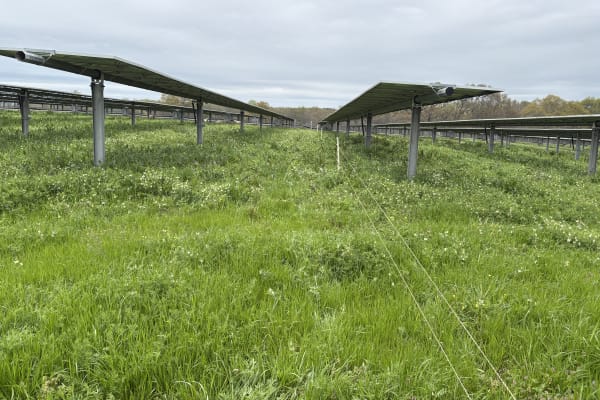
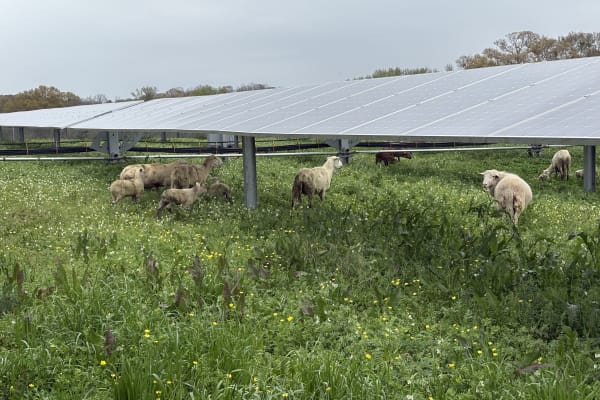
Solar grazing is simple. You've got a solar farm with vegetation growing underneath and between the panels. Instead of sending mowers and herbicide crews out there — risking panel damage every single time — you send sheep. Vegetation stays within spec. No ruts, no thrown rocks, no cracked glass.
The sheep eat the vegetation, fertilize the soil as they go, and move on to the next section. Rotational grazing, same way grasslands have worked for thousands of years. The panels keep producing. The land gets healthier. Everybody wins.
Nationally, over 113,000 sheep graze 129,000 acres across 500+ solar sites. Georgia is one of the fastest-growing solar states in the Southeast, and the demand for professional grazing services is growing right alongside it.
We're members of the American Solar Grazing Association — the leading industry organization with over 1,100 members across 45 states. We follow their best practices and stay current with the latest research in agrivoltaics.

Agrivoltaics (Dual-Use Solar)
The Future of Solar Is Agrivoltaic
We're not replacing farms. We're investing in farming.
What Are Agrivoltaics?
Agrivoltaics — what the U.S. Department of Energy and the solar industry call "dual-use" or "co-location" — is the practice of producing food and electricity on the same land at the same time.
Panels are spaced to let animals move freely underneath. The partial shade creates a cooler microclimate that reduces heat stress and cuts evaporation. And here's the thing most people don't realize: vegetation cooling keeps panel temperatures lower, which means better PV performance. The panels actually produce more electricity.
Source: U.S. Department of Energy, USDA Climate Hubs
Why Communities Prefer It
Conventional solar farms are often seen as industrial projects that take good farmland out of production. That's a hard story for county commissioners to defend and a real source of tension in rural communities.
Agrivoltaics flips the narrative: the land keeps farmland in production while generating power. Neighbors see a working farm with livestock, not a fenced-off industrial site. Survey research shows people significantly prefer agrivoltaic landscapes over conventional solar parks and are more willing to support them.
"This project keeps this county a farming community while bringing in clean energy, tax base, and jobs."
Protecting farmland, not paving it.
Why a Regenerative Farm
We're not a solar company that manages vegetation. We're a regenerative farm that builds soil. That's a fundamentally different starting point.
We understand compost science, rotational grazing, and native species establishment. When our sheep graze your solar site, we're not just cutting grass — we're building an agrivoltaic system where the land gets better every year.
- Natural fertilization improves the site over time
- ASGA member — professional standards
- Southeast specialists — we know Georgia
Case Study
On the Ground in Northeast Georgia
50-acre agrivoltaic solar site under active management near Lavonia, GA
A utility-scale solar installation in Northeast Georgia needed reliable, local vegetation management. The previous provider was driving long distances and the site needed a better solution.
We evaluated the site, designed a rotational grazing plan, and deployed our flock. 50 acres now under active agrivoltaic management — vegetation controlled, soil improving, zero panel incidents.

Why Solar Operators Choose Grazing
Clean energy deserves clean land management. Here's why grazing beats mowing.
Zero Panel Damage
Mowing equipment throws rocks, cracks glass, and severs wiring. Sheep walk under panels without contact. Zero equipment risk to your array.
Lower O&M Costs
Industry data shows solar grazing can cut vegetation management costs up to 75% compared to mechanical mowing — especially when you factor in panel damage claims.
Better Soil, Better Site
Natural fertilization and rotational grazing improve soil health over time. Your site gets better, not worse. Long-term asset protection.
Fire Risk Reduction
Consistent grazing keeps vegetation within spec year-round. Less dry fuel load means lower fire risk and better compliance with site safety requirements.
Zero Emissions
No diesel mowers, no herbicide applications, no chemical runoff. Clean energy deserves clean land management. Strengthens your ESG reporting.
Better Panel Performance
Vegetation cooling keeps panel temperatures lower. DOE research confirms cooler panels produce more electricity. Higher uptime, better yield.
Solar Grazing vs. Mechanical Mowing
The numbers speak for themselves.
| Mowing | Solar Grazing | |
|---|---|---|
| Cost per acre/year | $265+ | $400 - $600 |
| Panel damage risk | High | None |
| Herbicides needed | Yes | None |
| Carbon emissions | Significant | None |
| Soil health over time | Degrades | Improves |
| Fire risk reduction | Temporary | Consistent |
| Invasive species control | Poor | Excellent |
| Dust / panel soiling | Major source | Eliminated |
| Panel performance | Reduced by soiling | Improved (cleaner panels, cooler temps) |
| ESG / community story | None | Strong |
Less Mowing, Less Dust, Cleaner Panels.
Conventional mowing throws fine soil dust into the air. That dust settles on panels as soiling — cutting energy production by several percent between cleanings, with severe soiling in dusty environments documented at double-digit losses. By replacing mowing passes with grazing, you eliminate one of the major local sources of dust that ends up on the glass.
How It Works
Four steps. We handle all of them.
Site Assessment
We walk your installation, evaluate vegetation types, fencing needs, and panel layout. No cost, no obligation.
Custom Grazing Plan
Rotational grazing schedule designed for your site geometry, seasonal growth patterns, and any problem species.
Flock Deployment
Sheep arrive with portable fencing and water systems. Bo leads the grazing operation — you don't have to think about it.
Ongoing Management
Regular rotations, daily animal checks, progress updates. We work around your O&M schedules and site access rules.
We're comfortable working inside utility O&M, safety, and compliance requirements.
Solar Grazing & Agrivoltaics in Georgia
Georgia is one of the top solar-producing states in the country, and that capacity is growing fast. Every one of those installations — utility-scale and community solar alike — needs vegetation management. Right now, most of them are paying for mowing crews and herbicide applications that damage soil and risk panel breakage.
The Southeast advantage for solar grazing is significant. Our growing season is nearly year-round, which means consistent grazing without the long winter breaks that operations up north deal with. Warm-season grasses thrive here. And we've got plenty of the problem species — kudzu, johnsongrass, pigweed — that sheep handle better than any mower.
Based in Bogart, Georgia, we currently serve solar installations across Northeast Georgia, including our active site near Lavonia. For larger sites, we travel statewide.


Frequently Asked Questions
How do you protect panels and wiring?
Sheep are low-profile animals — they walk under panels, not over them. Unlike mowing equipment, there's zero risk of thrown rocks, cracked glass, or severed wiring. That's one of the main reasons the solar industry uses sheep specifically. We also use portable fencing to control where animals graze, keeping them away from any sensitive infrastructure.
How much does solar grazing cost per acre?
Contract rates typically range from $400 to $600 per acre per year, depending on site size and vegetation density. That's competitive with — or cheaper than — mechanical mowing when you factor in panel damage claims, herbicide costs, and long-term soil degradation.
What are agrivoltaics?
Agrivoltaics — also called dual-use solar — is the co-location of agricultural production and solar panels on the same land. Instead of fencing the array off from agriculture, the land produces food (or forage for livestock) and electricity at the same time. Solar grazing is one of the most practical forms of dual-use solar.
How many sheep per acre?
A typical solar grazing operation runs about 5 to 8 sheep per acre in rotation. We adjust based on vegetation density and seasonal growth rates. The animals rotate through sections so the land has time to recover.
What about winter?
Georgia's growing season is one of the longest in the country. We can graze nearly year-round here, which is a real advantage over operations up north. During slower growth periods, we adjust rotation schedules accordingly.
What makes your approach different?
We're a regenerative farm first. We understand soil biology, compost science, and rotational grazing at a level most vegetation management companies don't. We're not just cutting grass — we're building an agrivoltaic system where the land gets better every year. And we're ASGA members, so we follow industry best practices.
What about invasive species?
Sheep are excellent at managing common Southeast invasives like kudzu, johnsongrass, and pigweed. Targeted grazing can reduce invasive species pressure while encouraging native ground cover to establish.
We're Taking On New Sites for 2026
Free site assessment. Honest evaluation. If grazing makes sense for your installation, we'll show you the numbers. If it doesn't, we'll tell you that too.
Currently serving Northeast Georgia. Expanding statewide. Limited capacity for new 2026 solar sites.
Or call us at (706) 613-4415