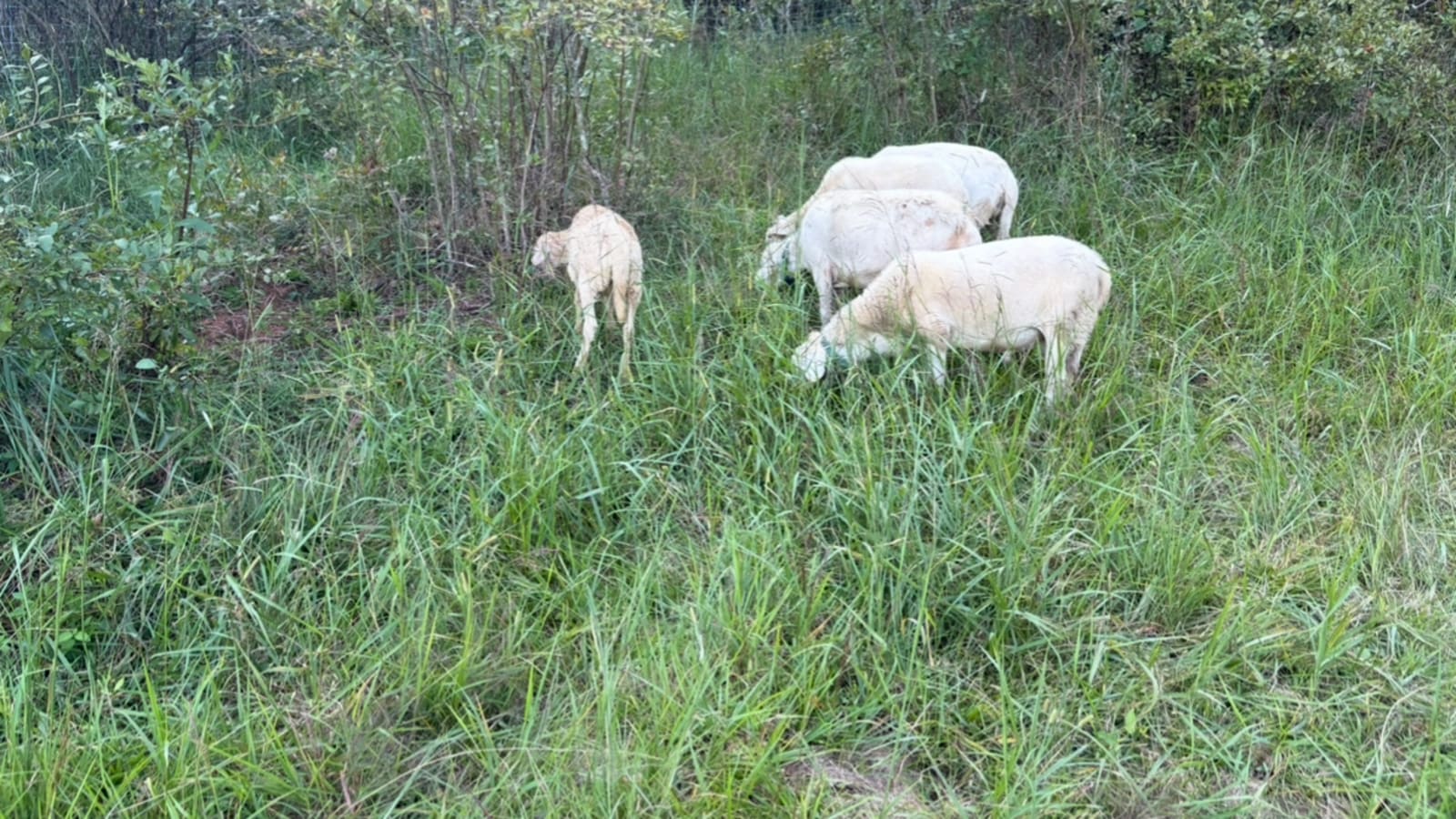
Sheep grazing under solar panels in Georgia
Farmers First. Always.

Not All Solar Grazing Is Created Equal.

Most solar grazers bought sheep to manage vegetation. We manage vegetation because we know sheep. That's a fundamentally different starting point — and the science proves why it matters.

"The horror stories asset owners tell — dead sheep, bare ground, sites that still need mowing — are exactly what the science predicts when someone without livestock experience puts animals under panels."

The Expertise Gap in Solar Grazing

Solar grazing is growing fast. Over 113,000 sheep graze 129,000 acres across 500+ solar sites in the U.S. But growth is outpacing expertise. Too many operators are solar contractors who bought some animals — not livestock producers who understand grazing management, animal health, and soil biology.

The result? Parasite-ridden flocks, eroding ground, concentrated manure that O&M crews complain about, and sites that still need mechanical mowing to stay in compliance. Asset owners get burned, and the whole industry gets a bad reputation.

National agrivoltaic programs — including NREL's InSPIRE and the Agrisolar Clearinghouse — now explicitly recommend that every grazed solar site have a written grazing plan with stocking rates, rotation schedules, rest periods, and vegetation standards. Not "put sheep out and hope for the best."

Source: Agrisolar Clearinghouse Best Management Practices

We're a regenerative farm in Bogart, Georgia. We understand compost science, rotational grazing, and native species establishment at a level most vegetation management companies never will — because this is what we do every day, not a side business we added to a solar contracting operation.

The Science

The Parasite Problem Nobody Talks About

In Georgia's warm, humid climate, internal parasites are the number one threat to sheep on solar sites. How you manage grazing determines whether you control them — or they control you.

The Biology

Barber pole worm (Haemonchus contortus) completes its lifecycle in about 20 days. A single female produces 5,000 to 15,000 eggs per day. Under continuous grazing, pasture contamination is exponential.

About 80% of infective larvae live in the first 5 centimeters of vegetation. When sheep graze the same ground continuously, they're walking through a minefield of parasites with every bite.

Sources: PMC6755402; SCOPS Veterinary Parasitology

How Rotation Breaks the Cycle

Research shows rotational grazing can cut worm burdens roughly in half compared with continuous grazing. Short grazing bouts of 3 to 4 days, followed by 35 to 60 days of rest, keep grass taller than the parasite zone and give larvae time to die off.

In warm climates like Georgia, infective larvae on pasture typically survive 30 to 35 days. Pastures become relatively clean by 90 days after contamination. Our rotation schedule is designed around this biology.

Sources: Missouri Extension G2613; PMC6755402

The Dewormer Trap

Most solar grazers lean on frequent, whole-flock deworming to compensate for poor grazing management. The science is clear: this fast-tracks drug-resistant worms. Resistance to all major dewormer classes is now documented in small ruminants across the U.S.

We use FAMACHA scoring and targeted selective treatment — treating only animals that need it, preserving drug effectiveness for when it actually matters.

Source: PMC9219448

What's Happening Underground

Vegetation management isn't just what you see above the soil. It's what's happening below it. And the way you manage animals determines whether your site's soil is building — or dying.

The Dung Beetle Problem

Ivermectin-heavy deworming programs don't just hit parasites inside the animal. The residues in manure knock back dung beetle populations by roughly two-thirds and slow manure breakdown across the entire pasture.

Without dung beetles, manure sits on the surface. Flies breed in it. Nutrients don't cycle back into the soil. O&M crews complain about the mess. And the "natural fertilization" that solar grazing promises? It never happens.

~66% decrease in dung beetle occurrence under conventional deworming programs vs. regenerative systems.

Source: SD State Extension; PLOS ONE

Building Soil, Not Depleting It

Multi-site research on commercial solar farms found that grazed sites had higher soil organic matter (4.14% vs 3.70%) and significantly better soil pH (6.20 vs 5.81) than non-grazed sites.

In the Southeast U.S. specifically, adaptive multi-paddock ranches showed over 300% higher standing crop biomass and about 13% higher soil organic carbon to one meter depth compared with continuously grazed operations.

That means better root systems, more resilient turf, fewer erosion headaches under your panels — and a site that gets better over the life of the project.

Sources: ASGA/NYSERDA; Agrisolar Clearinghouse; Teague et al.

Erosion Control

The Living Roller-Crimper

How high-density, short-duration grazing protects your site from erosion

Solar sites are built on construction-disturbed soil. Erosion is one of the most common — and expensive — problems asset owners face. Rills form under panels. Access roads wash out. Sediment moves.

Done right, high-density, short-duration grazing works like a living roller-crimper. Animals eat what they need and trample the rest into a mulch layer that armors the soil surface. Research shows this boosts water infiltration and reduces erosion compared to continuously grazed ground.

We use stock densities high enough to put litter on the ground and protect soil, but not the extreme levels that reduce animal performance. That balance is what separates a livestock producer from someone who read about mob grazing on the internet.

Sources: Sand County Foundation; NDSU Grazing Management; UNL Research

Managed grazing on solar site

What Goes Wrong Without Expertise

These aren't hypotheticals. They're what the science predicts — and what asset owners report — when grazing is managed by people who don't understand livestock.

Parasite Explosions

Continuous grazing in warm climates creates exponential parasite contamination. Thin, anemic animals under your panels — and a PR risk you don't want.

Drug Resistance

Frequent whole-flock deworming builds resistant parasites. Eventually, nothing works. The operation collapses — and the asset owner is left scrambling for a mowing crew mid-season.

Soil Degradation

Continuous grazing produces shallow roots, bare patches, compaction. On construction-disturbed solar sites, that means rills, sediment movement, and infrastructure risk.

Manure Accumulation

Dewormer residues kill the dung beetles that decompose manure. Result: persistent manure pats, fly problems, uneven nutrient distribution — exactly the opposite of what was promised.

Uneven Grazing

Understocked, unrotated flocks cherry-pick clover and ignore the rest. The site looks half-grazed, half-wild. You're paying for grazing and still sending in a mowing crew.

Infrastructure Damage

Without proper fencing and breed selection, animals rub on posts, chew cabling, and congregate in panel drip lines — creating compacted, muddy lanes and equipment hazards.

How We Do It Differently

Every decision is built on the biology of the animal and the ecology of the site.

1

Adaptive Multi-Paddock Grazing

Tight paddocks, 3 to 4 day rotations, high stock density. Animals eat everything — not just the candy. Rest periods of 35 to 60 days break the parasite lifecycle and let vegetation recover. The same way grasslands have worked for thousands of years.

2

FAMACHA Scoring & Targeted Treatment

We check every animal's mucous membranes to assess anemia — a direct indicator of parasite load. Only animals that need treatment get it. This preserves drug effectiveness, protects dung beetles and soil biology, and produces healthier animals.

3

Site-Specific Grazing Plans

Panel layout, shade patterns, and forage mix all affect how sheep use a solar field. We design rotations around your site geometry so animals clean up problem areas without overgrazing sensitive spots or congregating in drip lines.

4

Soil Biology as a Management Tool

We manage for the whole system — not just what's visible above ground. Healthy dung beetle populations. Active earthworm communities. Nutrient cycling that feeds the soil that feeds the forage that feeds the sheep. That's regenerative agriculture, applied to your solar asset.

The Research Is Clear

Published data comparing managed rotational grazing vs. continuous grazing and mowing-only approaches.

Metric Without Expertise SME Approach
Parasite burden Exponential growth ~55% reduction via rotation
Drug resistance risk High (whole-flock drenching) Low (targeted treatment)
Dung beetle activity ~66% decrease Preserved
Soil organic matter 3.70% (mowed only) 4.14% (grazed)
Standing biomass Baseline (continuous) >300% higher (AMP)
Soil carbon (to 1m) Baseline ~13% higher
Supplemental mowing needed Frequently Rarely
Site condition over time Degrades Improves every year

Sources: ASGA/NYSERDA multi-site study; PMC6755402; SD State Extension; Teague et al. (ScienceDirect); Agrisolar Clearinghouse

Why This Matters Even More in Georgia

Georgia is one of the fastest-growing solar states in the Southeast. It's also one of the most challenging environments for livestock management. Warm, humid conditions year-round mean higher parasite pressure, faster larval development, and less margin for error.

An operator in Minnesota can get away with longer rest periods and less intensive monitoring because the cold kills parasites over winter. In Georgia, there's no winter reset. You have to manage your way through it — every month, every rotation, every animal check.

That's why expertise isn't optional here. It's the difference between a solar grazing operation that works and one that creates more problems than it solves.

Questions Asset Owners Ask

What is FAMACHA scoring?

FAMACHA is a clinical method for assessing anemia in sheep and goats by examining the color of the lower eyelid mucous membrane. It was developed by South African researchers specifically to manage barber pole worm without blanket deworming. Only animals scoring 3 or above (on a 1-5 scale) receive treatment — preserving drug effectiveness in the flock and protecting beneficial soil organisms from dewormer residues.

How do you know your approach works on solar sites specifically?

Multi-site research published through the American Solar Grazing Association and NYSERDA has documented measurable improvements in soil organic matter and pH on grazed solar sites vs. non-grazed controls. NREL's InSPIRE program and the Agrisolar Clearinghouse both now recommend rotational grazing with written grazing plans as best practice for solar vegetation management. Our approach aligns directly with these research-backed recommendations.

We've had a bad experience with grazing before. Why would this be different?

Bad grazing experiences almost always trace back to the same root causes: continuous grazing without rotation, no parasite monitoring, understocking, and no written grazing plan. These are management failures, not failures of grazing itself. We operate a 65-acre regenerative farm — livestock management is our daily work, not a side business. We bring a written grazing plan, regular FAMACHA monitoring, adaptive rotation schedules, and agricultural expertise that most solar vegetation contractors simply don't have.

What about the manure? Our O&M crews have complained about it.

Manure complaints are a symptom of poor management, not an inevitable consequence of grazing. When animals are packed into tight paddocks and moved frequently, manure is distributed evenly rather than concentrated in shade spots. When you avoid blanket deworming, dung beetle populations thrive and break down manure within days. Under our system, manure is a fertilizer that cycles nutrients back into the soil — not a mess that sits on the surface for weeks.

Your Site Deserves Better Than Guesswork

We're farmers who happen to manage solar sites — not solar contractors who happen to own sheep.

Free site assessment. Written grazing plan. Agricultural expertise from day one.

Or call us at (706) 613-4415