50-Acre Solar Site in Northeast Georgia
How a regenerative farm brought agrivoltaic grazing to a utility-scale solar installation — and made the land better in the process.
The Challenge
A 50-acre utility-scale solar installation needed reliable, local vegetation management. The previous mowing provider was traveling long distances, driving up costs and reducing response time. The site's vegetation — a mix of warm-season grasses and emerging invasives — required consistent management to prevent panel shading and fire risk buildup.
Our Approach
We evaluated the site on foot, assessed vegetation types and panel layout, and designed a rotational grazing plan tailored to the installation's geometry. Our flock was deployed with portable fencing and water systems. Bo Carter leads the grazing operation, managing regular rotation through sections, giving each area time to recover while keeping the entire site under active control. This isn't just vegetation management — it's an agrivoltaic system where the land stays in agricultural production while generating clean energy.
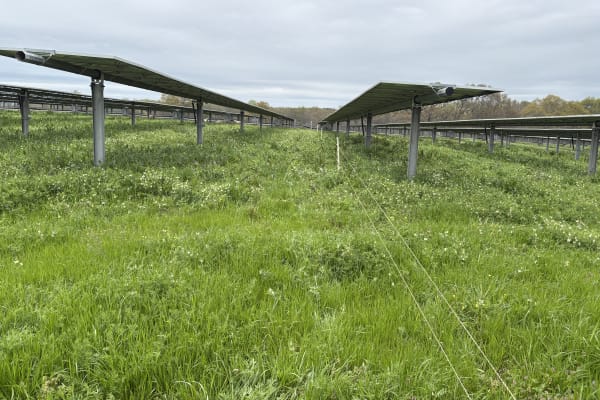
Active grazing between panel rows

Vegetation management across the 50-acre installation
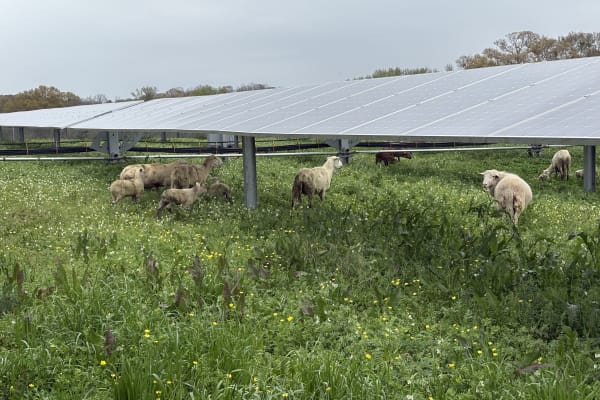
Rotational grazing keeps vegetation at optimal height
Results
- Site under active, ongoing management with regular animal oversight
- Vegetation controlled across all 50 acres without mowing equipment
- Zero panel incidents — no thrown rocks, no cracked glass, no severed wiring
- Soil health improving through natural fertilization and rotational grazing
- Local operator eliminates long-distance travel costs for the site owner
- Land kept in agricultural production — a true dual-use agrivoltaic system
What Makes This Agrivoltaic?
This isn't just vegetation management. By keeping sheep on the land, we maintain active agricultural production on the same acres that generate clean energy. The U.S. Department of Energy calls this "dual-use solar" or agrivoltaics — and it's the future of how solar installations and rural communities can work together. The land stays productive. The community sees a working farm, not an industrial site. And the panels perform better because vegetation cooling keeps temperatures down.
Is Your Solar Site a Fit?
We're taking on new sites across Georgia for 2026. Free assessment, honest evaluation.